


Reviews

By JANET MASLIN, 9/1991
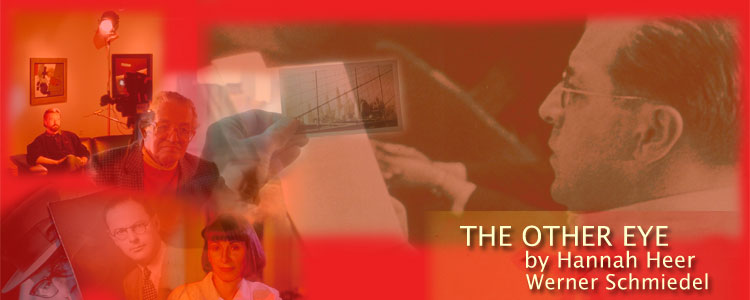
"The Other Eye" examines the career of G.W.Pabst, the Austrian-born director who is best known for his work with Louise Brooks ("Pandora's Box," "Diary of a Lost Girl") and least well known for those films he made under the auspices of the Third Reich. This documentary by Johanna Heer and Werner Schmiedel pays particular attention to the latter chapter in Pabst's life, and to the connections between an artist's work and the political climate in which it is engendered.
Interviewing an assortment of film scholars and first-hand observers of Pabst's work, the film makers assemble a meandering but often illuminating portrait. Among those providing details of Pabst's history are Anne Friedberg of the University of California, who discusses the director's collaboration with Sigmund Freud in the 192O's on "Secrets of a Soul," a film that attempted to dramatize the process of Freudian analysts and included some remarkable dream sequences, which are glimpsed here briefly in film clips. Ms. Friedberg, in one of the film's many interesting digressions, also mentions an attempted collaboration between Freud and Samuel Goldwyn that would surely have been bizarre had it come to pass.
Francis Lederer, looking remarkably fit and vigorous here, describes his acting experiences in "Pandora's Box" with Brooks. "Naturally, it was like talking to a sphinx," he says of the actress, with whom he did not share a common language at the time. Harold Nebenzal, whose father, Seymour, was the producer of much of Pabst's best work, recalls a close friendship between the two families. The great cinematographer Henri Alekan describes Pabst's way of holding preproduction meetings and welcoming ideas from members of his cast and crew, which was unusual for its time.
The sense of Pabst that emerges from the first part of the film is often scholarly but impersonal. Much more is revealed, for instance, about his relations with a film journal that especially revered him than about what sort of character and background he brought to his work. Only when it focuses on Pabst's return to Europe, after a largely unsuccessful stint in Hollywood, does the film take on much urgency.
The directors are quite clear in excoriating a director who worked under the watchful eye of Joseph Goebbels, no matter how seemingly apolitical his films may have been.
Although "The Other Eye" includes numerous clips from Pabst's films, even more would have been welcome, especially of those films whose underlying meanings are most in dispute here. Glimpses of two costume films made under the Nazi regime, "Comedians" and "Paracelsus," are intriguing but brief.
"For goodness' sake', I didn't think politics had anything to do with it!" exclaims the actress Hilde Krahl, who appeared as a young girl in "Comedians." But Ms. Krahl later bursts into tears, quite movingly, in describing her own remorse over having remained in Germany during the war. Pabst, it is noted, often brandished unused tickets for an ocean crossing and spoke of sudden illness and the outbreak of war to explain why he himself did not leave.
After the war, Pabst made some notable efforts to come to terms with the Nazi past; the film includes clips from "The Trial," with a scene set in a synagogue, and "The Last Ten Days," depicting Adolph Hitler in his bunker. "I believe it was a very difficult time for my father," says Michael Pabst, the director's son, with considerable understatement.
"Pabst never knew the impression it made to go back in l939," says Jean Oser, another of the director's frequent collaborators. As the film makes clear, the director may not have understood the implications of his actions at the time, but they became unavoidable for him later.
"The Other Eye" will be shown tonight at 6:15 as part of the New York Film Festival.

"The art of documentary appears to be taking a personal turn lately, with nonfiction films reflecting not only broad social or political issues, but also the experiences and personalities of their makers. That's the most vivid trend to emerge from this year's New York Film Festival, where several important new documentaries were unveiled. (...)
History mingles with cinema again in The Other Eye, about the career of G. W. Pabst, the Austrian director who made classics like "Pandora's Box" and "Diary of a Lost Girl," and boosted actress Louise Brooks to international renown in the silent-film era. Less widely known is the fact that Pabst voluntarily returned to Austria after it had been absorbed by the Third Reich, and proceeded to direct films under Nazi auspices - a career move that few would have expected from this urbane, sophisticated artist. The Other Eye probes this situation, and the guilt Pabst apparently felt in later years, with a seriousness rarely found in movies about moviemaking.
Johanna Heer and Werner Schmiedel have no direct connection with the subject of their film. Yet they make it personal with their unusual directorial style, using expressionistic colors and subtle, seemingly unmotivated camera movements. The directors have told me that each of these movements has a different meaning - perhaps evoking a sense of loss in one case, or revealing a background detail at a carefully chosen moment. What fascinates me about their style, however, is its tendency to destabilize and defamiliarize the filmed image during shots that might otherwise seem flatly conventional and lacking in irony. In any case, the film is exceptionally successful at bringing a little-known subject to life."
--David Sterritt, THE CHRISTIAN SCIENCE MONITOR